Ethanol’s role in electric vehicles
Will Northrop
Will Northrop
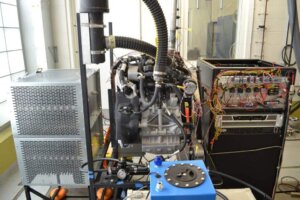
While the environmental and economic benefits of electrified vehicles is clear, the technology has not yet made it possible for long-range trips. Corn-based ethanol could be a key factor in the solution allowing electrified vehicles to travel long distances, by producing an ethanol range extender.
Northrop is leading a research project using E85 in an internal combustion engine that charges the battery, acting as an ethanol range extender for electrified vehicles. His team is working with a BMW i3 REx engine generator, powered by E85. The engine would be under the hood of future electrical vehicles, but not connected to the wheels. Instead, it would serve as a battery charger using the power of thermochemical recuperation (TCR).
TCR utilizes the waste heat from an engine to reform a portion of the incoming fuel to a fuel mixture that has higher caloric value, thus providing more energy. Ethanol is the ideal fuel for this process because it can more efficiently be made into hydrogen and carbon monoxide than standard unleaded gasoline. E10 requires more energy to reform, thus decreasing the engine’s efficiency.
Currently, electrified vehicle technology has been unsuccessful in lowering the cost per kilowatt hour for longer-duration drives, making range-extending engines a possible solution. Northrop said major car companies are exploring more range-extender models, including Nissan, which already has a successful range-extender electrified vehicle in Japan.
The process is not only a win in terms of energy efficiency, it also comes with tremendous environmental benefits. Using higher blends like E85 in the process has the potential to greatly cut down on particle emissions.